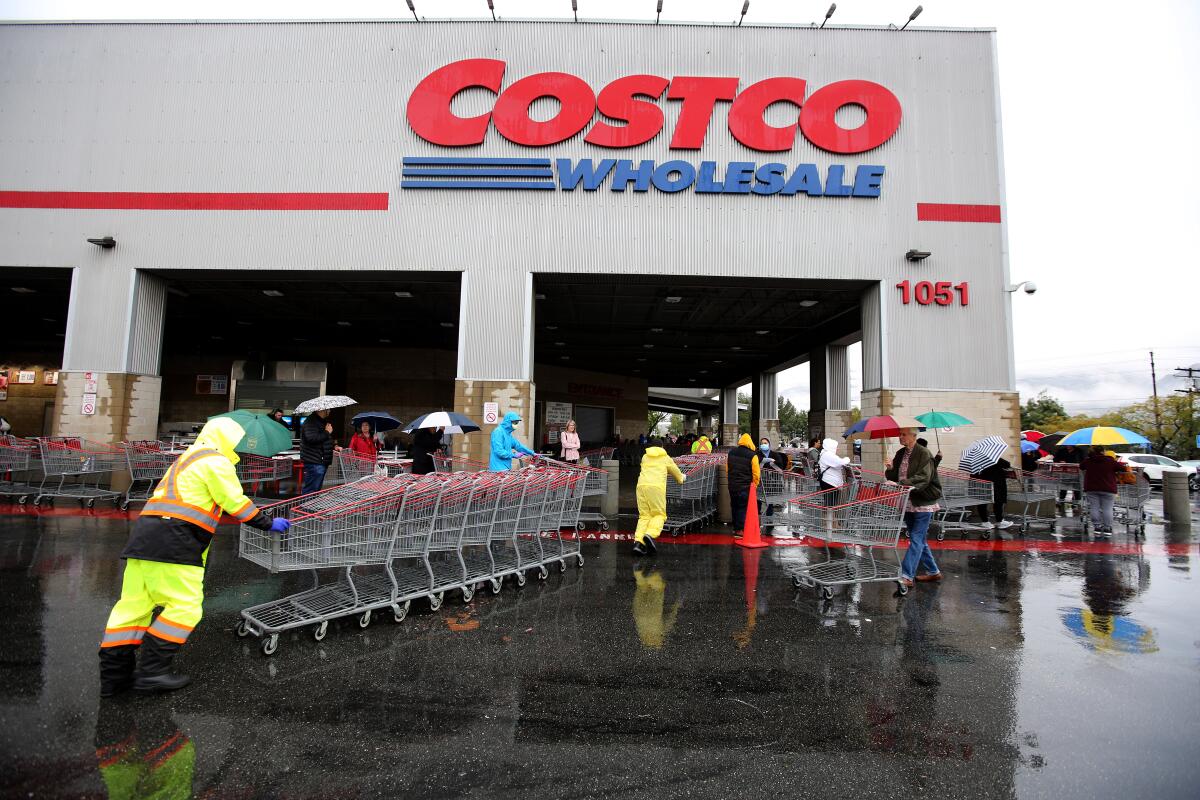
About a third of Costco’s U.S. sales come from imported goods, with major sources being China, Canada and Mexico.
(Raul Roa / Los Angeles Times)

By
Nilesh ChristopherStaff Writer
FollowDec. 2, 2025
Updated
2:08 PM PT
4 min
Click here to listen to this article
Share via
Close extra sharing options
Email Facebook X LinkedIn Threads Reddit WhatsAppCopy Link URL
Copied!
0:00
0:00
1x
This is read by an automated voice. Please report any issues or inconsistencies here.
Costco is suing the Trump administration to reclaim tariff payments, claiming the president lacks legal authority to impose import duties without Congress.
The warehouse giant joins a growing list of companies challenging the tariffs.
About a third of Costco’s U.S. revenue comes from imported goods, particularly from China, Canada and Mexico, putting the retailer at heightened financial risk.
Costco is suing the Trump administration, seeking a full refund of the import taxes it paid under President Trump’s executive orders earlier this year.
The discount retailer, a big importer, wants the U.S. government to stop imposing tariffs on goods Costco brings into the country until the Supreme Court weighs in on the legality of executive orders.
According to the lawsuit filed Friday with the United States Court of International Trade, Costco wants the court to declare that the president lacks authority under the International Emergency Economic Powers Act to set tariffs, and has challenged the tariff orders as unlawful.
Advertisement
Tariffs are taxes imposed on imported goods. Traditionally, tariffs are levied after getting congressional approval, but in February, Trump invoked a 1977 “national emergency” law — used for sanctions — to issue global tariff orders, bypassing the traditional process.
The Supreme Court is now deliberating the legality of the tariff orders.
“Whether Costco is successful through its lawsuit in getting compensated for the tariffs that it has already paid on its imports really depends on the Supreme Court’s decision on whether the president has the legal authority to impose tariffs,” said Devashish Mitra, a professor of economics and global affairs at Syracuse University.
Costco is the latest in a growing list of businesses, including motorcycle maker Kawasaki, beauty product maker Revlon and others that are suing the Trump administration for refunds if the Supreme Court strikes down Trump’s economic policy.
Advertisement
While there could be valid national security reasons under which the president has authority to set tariffs, tariffs on imports such as shirts or sheets are inappropriate and illegal, critics say.
“A blanket tariff on all types of imports from a country or several countries with a single stroke of the president’s pen will be very difficult, if not impossible, if other bases for tariffs are invoked,” Mitra said.
About a third of Costco’s U.S. sales come from imported goods, with major sources being China, Canada and Mexico.
Advertisement
In its suit, Costco highlighted that most imports from China faced a minimum 145% tariff, which has impacted its orders.
Trump has boasted that tariffs helped reduce the trade deficit, and as of October, brought in $205 billion in revenue for the federal government in 2025.
The policies have disrupted the retail sector and thrown every industry, from retailers to toymakers, into disarray.
Advertisement
Some have attempted to rework supply chains to source domestically or from countries not impacted by tariffs to keep costs low, while others are compelled to introduce products at cheaper price points for buyers to afford.
Companies are passing the costs onto consumers. Some are absorbing part of the additional costs and taking a hit to their profit to avoid raising retail prices too much.
Prices began rising immediately after the broader tariff measures were announced in early March and continued to increase gradually over subsequent months, with imported goods rising roughly twice as much as domestic ones, according to the National Bureau of Economic Research.
“We are going to do everything we can to mitigate tariff impacts,” Ron Vachris, CEO of Costco, said in a September earnings call. “The last effect would be we pass on price. If we do that, we are going to be the last one to go up and always [be] the first one to go down in any opportunities we have out there.”
More to Read
 Why Trump’s tariff strategy could survive a Supreme Court defeat
Nov. 7, 2025
 Trump’s worldwide tariffs run into sharp skepticism at the Supreme Court
Nov. 5, 2025
Voices
Contributor: The Constitution is clear when it comes to Trump’s tariffsNov. 4, 2025