
Community police patrol the autonomous Indigenous community of Sevina, Mexico, in November.
(Eduardo Verdugo / Associated Press)
By
Patrick J. McDonnelland
Cecilia Sánchez Vidal
Dec. 16, 2025
3 AM PT
Share via
Close extra sharing options
Email Facebook X LinkedIn Threads Reddit WhatsAppCopy Link URL
Copied!
Mexico ranks among the world’s top five nations for extortion, which is often called ‘the invisible crime.’
An anti-extortion campaign faces a major problem: victims fear reprisal and distrust authorities.
Owners of businesses large and small say they have little choice but to pay protection money. “We live in terror,” one says.
MEXICO CITY — A shop owner facing threats shutters the clothing store that had been in his family for generations.
A leader of a citrus growers association is kidnapped and killed after refusing mob demands for a cut of profits.
Enraged peasant farmers fed up with paying graft turn on cartel thugs in a bloody showdown.
Advertisement
In Mexico, these real-life incidents all arise from a signature offense: extortion.
Gang shakedowns are rampant in Mexico, victimizing untold numbers — street vendors and taxi drivers, restaurateurs and farmers, factory owners and mine operators. All are coerced into paying tithes to criminal bands, sometimes the same cartels that run drugs.
“It’s a very sensitive crime because of its social impact,” Mexican President Claudia Sheinbaum said last week. “It doesn’t only affect one person. It affects everyone.”

An agent of the attorney general’s office in Mexican state of Michoacán inspects the area where vehicles were burned by members of criminal gang near the city of Quiroga in November.
(Enrique Castro/AFP via Getty Images)
Advertisement
Sheinbaum launched a high-profile crackdown against extortion, but her efforts face steep odds. Extortion, experts say, is a multibillion-dollar racket, perhaps even more lucrative than drug-trafficking. It sometimes is called “the invisible crime,” since most victims fail to report threats, fearing retaliation.
Those targeted often confront a ghastly choice: accept ultimatums to hand over cash, property or other assets — or face death, a threat routinely aimed at family members as well.
“Sure, I can say, ‘I won’t pay: They can go ahead and kill me,’ ” said Antonio, a floriculturist outside Mexico City who hands over almost $600 in derecho de piso [protection] at each flower harvest, the amount doubling in holiday seasons, including this month’s Virgin of Guadalupe feast. “But I cannot allow them to kill my kids. Or take my wife.”
Like other victims who spoke to The Times, Antonio, 56, a father of four, asked that only his first name be used for security reasons.
“We live in terror,” he said. “We have to work for these delinquents. And no one in the government helps us.”
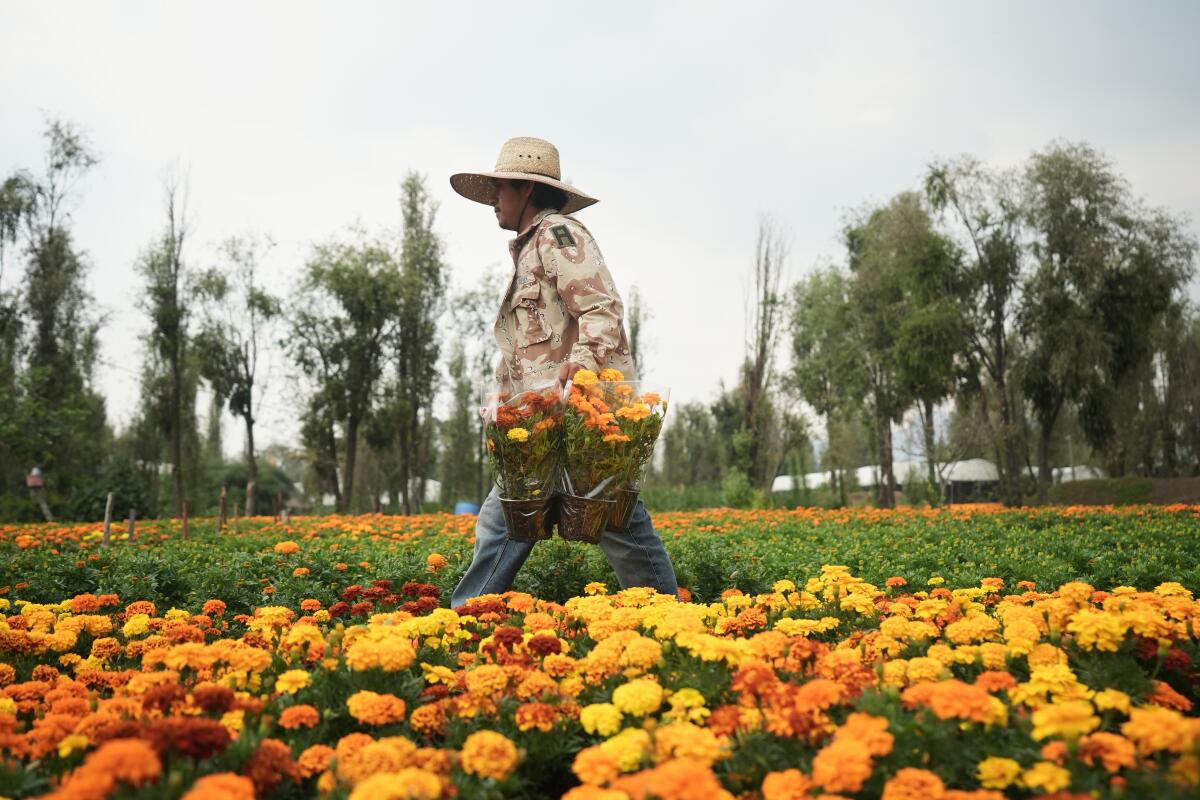
Farmer Jesús Cuaxospa works on his farm where he grows cempasúchil flowers in San Luis Tlaxialtemalco on the outskirts of Mexico City in October.
(Claudia Rosel / Associated Press)
Mexico and two other Latin American countries, Colombia and Honduras, are among the world’s five most extortion-scarred nations, according to the Global Organized Crime Index, an annual ranking from a Geneva-based research group. Filling in the top five are Somalia and Libya.
Advertisement
Apart from the devastating impact on individuals and families, extortion exacts extreme societal costs: displacement, a profound sense of insecurity and the distortion of local economies.
In Mexico, strong-armed extortion gangs have been accused of price-fixing, taking over industries, unions and transport routes, and running construction sites —and even setting prices for foodstuffs, building materials and other items.
Sheinbaum regularly boasts of her administration’s success in curbing violent crime, especially homicides, down by more than one-third since she took office last year, according to official figures. But she concedes that extortion is on the rise, though there are no accurate metrics for an offense so hugely under-reported.
Calling the eradication of extortion “one of the great challenges” facing Mexico, Sheinbaum pledged to bolster enforcement, stiffen penalties and increase safeguards for anyone receiving threats.
 For SubscribersThis Mexican city had one of the world’s highest homicide rates — so it fired most of its police
Mexico once vowed to reform its police. That has been abandoned as the country deploys soldiers to fight cartels.
Aug. 3, 2025
She is championing a constitutional amendment to make extortion a federal crime and put the onus on law enforcement, not individuals, to hunt down violators. Prosecutors could pursue cases without victims having to file complaints.
Since the inauguration of Mexico’s “National Strategy against Extortion” in July, authorities say police have arrested more than 600 suspects and fielded more than 100,000 calls to an expanded toll-free extortion hotline. Officials also moved to block cellphone access in Mexican prisons, where gangs specialize in “virtual kidnapping” — calling people on the outside and demanding ransoms for loved ones allegedly abducted.
Advertisement
“Don’t answer a telephone number that you don’t recognize,” Sheinbaum warned people last week.
In one notorious case, authorities say a prison gang targeted 14 nurses who were dispatched to Mexico City during the COVID-19 pandemic. Inmates using cellphones warned the nurses to stay in their hotel rooms and say nothing — they supposedly were under surveillance. Accomplices contacted relatives demanding cash. But police got wind of the scheme. No money was paid and no one was injured.
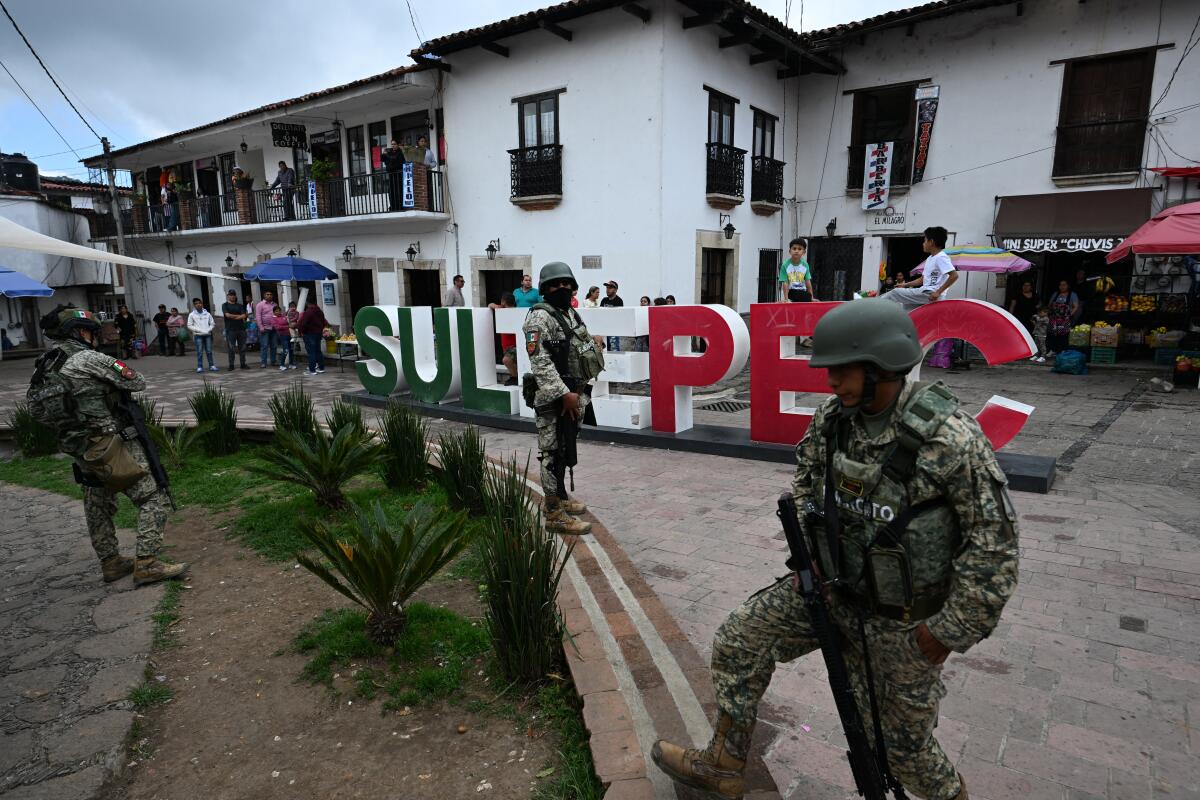
Security forces stand guard following an operation at a butcher shop allegedly linked to the
La Familia Michoacana
cartel in Sultepec, Mexico, in July.
(Alfredo Estrella/AFP via Getty Images)
Sheinbaum’s anti-extortion campaign faces a major barrier: Barring a massive culture shift, many victims will remain hesitant to approach the law, lacking trust in the system.
“Making a complaint is not an option, because you never know if authorities are in collusion with the criminals,” said César, co-owner of a restaurant in downtown Mexico City.
About two years ago, he said, one of his partners began to receive threats on his cellphone. The callers had the name of his wife and children. The partner was nervous but did nothing at first.
Advertisement
“Then one day two South Americans arrived at the restaurant,” César recalled.
Their message: Pay $2,500 a week to be “allowed to work in peace.”
His partner soon abandoned the restaurant, and the city.
Management hasn’t heard from the goons since.
Even so, César, like the owners of many businesses, tries to keep a low profile; his name and those of associates aren’t on display at the restaurant. Staff is instructed not to blab to anyone.
“Still, we live with uncertainty and worry all the time that these guys will come back,” César said. “We know that at any moment we could be victims.”
Recent victims whose cases shocked Mexico include a successful young butcher entrepreneur in Tabasco state and a woman taxi driver in Veracruz state. Both were found dead after rejecting extortion threats, according to reports. The driver, Irma Hernández, 62, a retired teacher, was kidnapped and forced to make a jihadi-style video in which — surrounded by armed men — she implored her fellow cabbies: “Pay your cuota [fee] ... or you’ll end up like me.”

Avocado growers have received so many extortion demands from criminal gangs that some hired private security forces, like this one on patrol in Tancitaro, Michoacán, in 2019.
(Gary Coronado/Los Angeles Times)
Sometimes, though, the fed-up marks fight back.
Two years ago the corn and bean growers of the impoverished hamlet of Texcapilla tired of paying annual protection fees of about $200 per planted acre and decided: No más. Armed with machetes and shotguns, the peasant farmers confronted enforcers of the dominant area cartel, La Familia Michoacana, on a soccer field outside a school. By the time the melee ended, authorities said, 14 were dead —10 gang members and 4 farmers.
Carlos Manzo, the former mayor of Uruapan in Michoacán state, also pushed back. He blamed Sheinbaum’s government for not doing enough in Michoacán, where gangsters have long fleeced the booming avocado sector and other industries.
“We are surrounded by criminal groups dedicated to extorting and killing,” Manzo told a crowd in May. “But we are going to confront them.”
Advertisement
Manzo was assassinated last month at a Day of the Dead celebration in Uruapan.
 Trump wants to attack cartels. Many Mexicans welcome it
Many Mexicans, desperate for security, now back limited U.S. military help against cartels despite President Claudia Sheinbaum’s vow to bar foreign intervention. President Trump has offered to send U.S. forces into Mexico to hunt down cartels.
Dec. 5, 2025
Less than two weeks earlier, Bernado Bravo, a leader of regional lime growers in Michoacán, also was shot dead. Bravo repeatedly had denounced extortion demands.
With so much at risk, it’s not surprising that some potential victims bolt. .For more than 80 years, Vicente’s family ran a men’s clothing business in downtown Mexico City. He didn’t think much of it when, about four years ago, men began calling demanding money. Then one day three guys arrived at the shop.
“They said if I didn’t pay, I would lack security, and if I lacked security, something might happen to my workers — if not to me, to my family,” Vicente recalled.
Like many targets, Vicente hoped the threat would go away. But the menacing strangers kept barging in — and upping their demands, from $500 a month to $1,000 a month to $2,000 a month, all the way up to $10,000 a month.
His sons urged Vicente to walk away: The business, however beloved, wasn’t worth a bullet to the head. Reluctantly, Vicente finally agreed. The shutdown left 15 people out of work, many of them longtime employees. Some ended up hawking clothing from street stalls.
Advertisement
Vicente says he never reported the extortion attempt: Like César, he feared some crooked law enforcement insider would reveal his name and address to the mob. He has tried to put the experience behind him. But it hasn’t been easy. Three generations of family life revolved around that shop.
“Because I refused to pay extortion I was forced to shut down the business that my grandfather founded in 1936, and that my father and I continued,” said Vicente, 67. “It was painful. Very painful.”
McDonnell is a staff writer and Sánchez Vidal a special correspondent.
More to Read
 Slaying of Mexican mayor sparks national outcry over cartel power
Nov. 9, 2025
 Smashed windows, threats and $800 a month: Witness details L.A. County gang extortion
Nov. 20, 2025
 Gold, guns and cartels: The battle for a billion-dollar mine
Nov. 6, 2025